Agentic Workflows: Achieve 3.7x ROI with AI in 2026
62% of companies are already experimenting with AI agents, but only 26% move beyond the testing phase. By the end of 2026, 40% of enterprise applications will use Agentic Workflows, achieving 3.7x ROI. Learn the concrete implementation plan for autonomous AI agents in enterprises.

62% of companies are already experimenting with AI agents. But only 26% move beyond the testing phase. Why? Because they treat AI like a better chatbot, not as an autonomous system. That's about to change.
By the end of 2026, 40% of enterprise applications will use Agentic Workflows. Companies that do this correctly will achieve 3.7x ROI. The rest? They'll burn through budgets and join the 85% of AI projects that fail.
In a moment, I'll show you how to move from simple automations to systems that make decisions on their own. And why this isn't science fiction — it's the 2026 standard.
From Tasks to Autonomy: Why 2026 Is the Year of Agentic Workflows
Over the last 3 years, we've only seen the tip of the AI iceberg. Chatbots answering questions. RPA scripts clicking through spreadsheets. Copilots suggesting code.
That's not an Agentic Workflow. Those are individual tools.
Agentic Workflows are something different: a system of AI agents that understand context, make decisions, and execute entire end-to-end processes. Without your involvement.
Take IT helpdesk. Traditional chatbot: "Ticket #12345 created, we'll get back to you." Agentic system: diagnoses the problem, checks logs, restarts the service, tests the solution, informs the user. Zero humans in the loop.
Why exactly 2026? Gartner predicts that by the end of this year, 40% of enterprise applications will have built-in AI agents. These aren't predictions — they're reactions to the numbers.
Companies that have implemented agentic systems see an average of 410% ROI after 3 years. That's not 10% more efficiency. That's a fundamental shift in business model.
The shift to autonomy eliminates the biggest bottleneck of traditional automation: the human in the decision-making process. McKinsey shows that projects with full end-to-end AI integration generate 25% cost savings. Those without? Barely cover implementation costs.
If your competition is already testing Agentic Workflows, you have maybe 6-9 months of advantage. After that, it becomes standard, not a differentiator.
370% Return on Investment: Data on AI ROI in Enterprises
Let's drop the marketing speak. Here are hard numbers from 2024-2025 implementations:
Market Numbers:
- $3.70 return for every $1 invested in agentic systems
- 410% ROI after 3 years (McKinsey study of 500 companies)
- 40-60% reduction in project execution time through AI orchestration
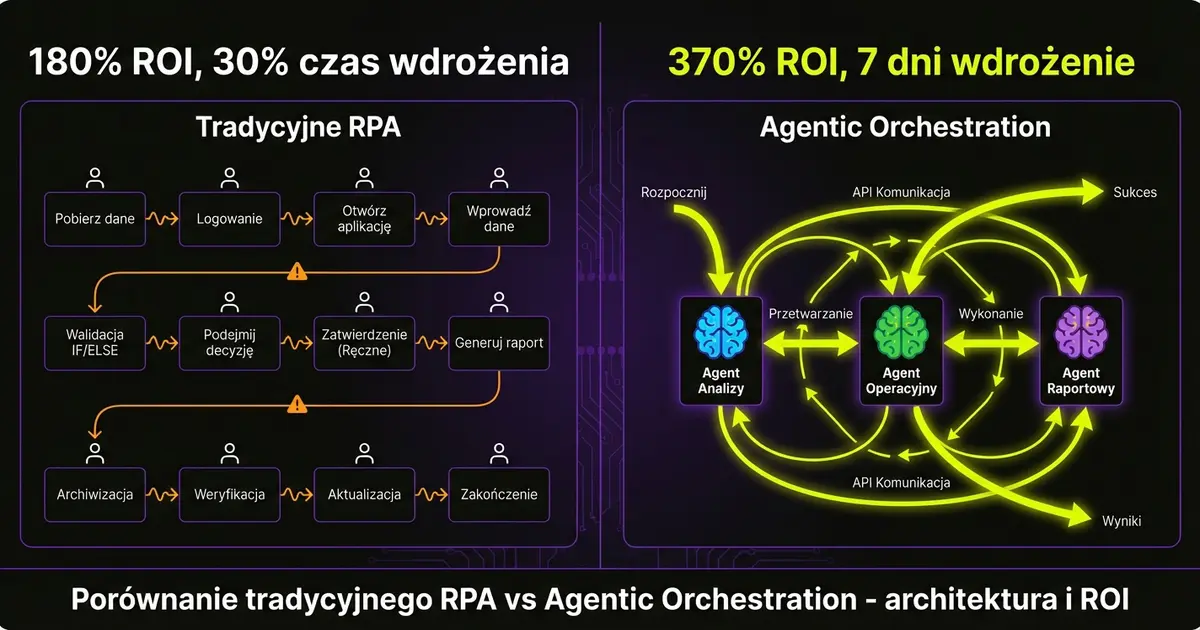
For comparison: traditional RPA delivers ~180-200% ROI. Good, but not revolutionary.
What makes the difference? Scale. RPA automates a task. Agentic Workflow automates the entire decision-making process.
Take JPMorgan and their COIN system. Before implementation, 360,000 hours of lawyer work per year went into analyzing credit agreements. After deploying the AI agent? Seconds. Zero errors. Full regulatory compliance.
Or Fidelity Investments: 50% reduction in contract execution time. Mastercard: 20-300% improvement in fraud detection (yes, three hundred percent — not a typo).
But there's a catch. These numbers apply to companies that did it right. 85% of AI projects fail. 42% of companies abandoned implementations in 2025 due to costs.
The difference between 3.7x ROI and burning through budget? Implementation strategy. I'll get to that in a moment.
One more thing: "high performer" companies (top 20% in AI adoption) allocate >20% of their digital budget to AI. Not 5%. Not 10%. Twenty percent. Because they know this isn't a cost — it's an investment with measurable returns.
Zest AI (fintech) shows this concretely: $1-12M in additional annual profit just from better loan underwriting. One process. One AI agent.
What Is AI Orchestration? Moving From Prompts to Results
AI orchestration isn't a buzzword. It's an architecture that connects agents into a working system.
Imagine an Order-to-Cash process in e-commerce:
- Sales Agent receives the order
- Inventory Agent checks stock
- Finance Agent approves credit
- Logistics Agent plans shipment
- CS Agent handles follow-up
Each agent has its own domain expertise. Each makes decisions autonomously. But they work together, passing context to each other.
This isn't a pipeline of scripts. It's orchestration — agents communicate, negotiate priorities, react to real-time changes.
Traditional RPA? "If condition A, do B." Static, brittle, requires updates with every process change.
AI orchestration? "Achieve goal X, given data Y and constraints Z." The agent decides how.
A wealth manager (McKinsey data) plans to save $1 billion (20% of cost base) through AI orchestration in back-office operations. Not through layoffs. Through reallocating people to value-generating tasks.
Key difference: resilience to change. An RPA system breaks when an application's UI changes. AI orchestration? It adapts. The agent sees the endpoint changed, tries an alternative path, logs the issue, continues working.
This is the shift from "execute step by step" to "achieve the outcome." From imperative programming to declarative goal management.
Companies that understand this difference reduce automation implementation time by 40-60%. Because they don't have to map every step — they just define the goals.
Hyperautomation 2026: How Autonomous AI Agents Transform Your Company
Hyperautomation isn't "more automation." It's automation of automation.
In 2026, you won't be deploying agents. You'll be deploying ecosystems of agents that self-optimize processes.
An autonomous AI agent has 4 characteristics:
- Perception - understands context from multiple sources (APIs, documents, databases)
- Reasoning - makes decisions based on data and business rules
- Action - executes tasks in systems (CRM, ERP, email)
- Learning - improves performance based on outcomes
Real-world example: a financial anomaly detection system. The agent doesn't just flag a transaction — it analyzes context (customer history, industry patterns, regulations), makes a decision (block/alert/allow), executes the action, documents everything.
Without humans. In real time.
This changes organizational structure. When 78% of sales cycles shorten thanks to AI, your sales team isn't making cold calls. They're closing strategic deals that the AI agent prepared and qualified.
70% larger transactions (from implementation data) isn't coincidence. It's an AI agent analyzing 1000x more buying intent signals than a human.
Or customer success: 30% lower operating costs with higher satisfaction. Because the agent handles 95% of routine issues, and humans focus on the 5% of cases requiring empathy.
41% of employers plan workforce reduction within 5 years through automation. Sounds brutal. But the truth is different: companies reallocate people to roles AI can't do. Strategy. Relationships. Creativity.
JPMorgan didn't lay off lawyers after deploying COIN. It shifted them from contract analysis to negotiation and deal structuring. Added value increased 10x.
Agent autonomy isn't replacement. It's augmentation. The question: is your company preparing for this transformation, or betting on status quo?
Agentic AI vs RPA: Building an Intelligent Process Ecosystem
RPA was great in 2018. In 2026? It's legacy.
The difference between RPA and Agentic AI is like the difference between a calculator and a financial analyst.
RPA:
- Executes tasks according to script
- Breaks when interface changes
- Requires mapping every step
- ROI ~180-200%
- Implementation time: 2-4 months
Agentic AI:
- Achieves goals through reasoning
- Adapts to changes
- Requires only outcome definition
- ROI ~380-410%
- Implementation time: 1-2 weeks (with proper infrastructure)
An intelligent process ecosystem combines both worlds. RPA for deterministic tasks ("copy data from A to B"). AI agents for decisions and context.
Example: B2B customer onboarding process.
RPA layer: Creates accounts in systems, generates documents, sends notifications.
Agentic layer: Sales Agent analyzes customer company, recommends package, negotiates terms. Compliance Agent checks regulations, approves documents. CS Agent plans first-month engagement.
Result: process drops from 14 days to 3. Zero errors. 100% compliance.
But watch out: 70-85% of AI projects fail. Why?
Error #1: Trying to replace RPA with AI 1:1. Doesn't work. AI requires new architecture.
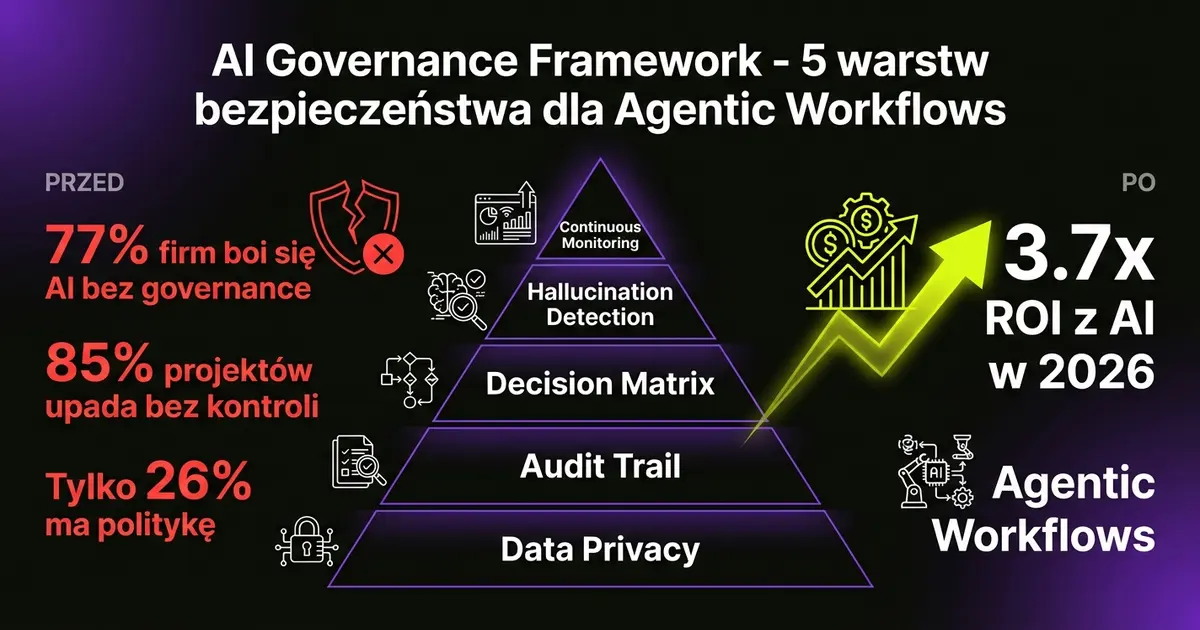
Error #2: No governance. 77% of companies fear AI hallucinations. Only 26% have AI governance policy.
Error #3: Big bang approach. Companies try to automate everything at once. Result? 39% of CS bots were withdrawn in 2024 due to errors.
Good implementation? Start small, scale fast. One process. One agent. Measure ROI. Scale.
Fidelity Investments started with contracting. 50% time reduction. Then procurement. Then operations. After 2 years: $140M annual savings.
Not revolutionary change. Evolutionary scaling.
5 Steps to Implementing Agentic Workflows in Your Organization
Let's drop the theory. Here's a concrete implementation plan:
Step 1: Process Audit (Week 1)
Identify 3-5 processes with highest ROI potential. Look for:
- High volume (>100 transactions/month)
- High cost (>20h work/week)
- High error rate (>5% errors)
- High friction (long execution time)
Tool: Process mining software (Celonis, UiPath Process Mining). Or just Excel and a stopwatch.
Step 2: Pilot on One Process (Weeks 2-4)
Choose ONE process. Not five. One.
Build an MVP agent: basic reasoning, 2-3 actions, clear success metrics.
Example: Lead Qualification Agent
- Input: Contact form
- Reasoning: Company analysis (revenue, industry, tech stack)
- Action: Scoring + routing to appropriate sales rep
- Metric: Meeting conversion rate
Implementation time: 2-3 weeks. Cost: $5-15k (tools + configuration).
Step 3: Measure & Iterate (Month 2)
30 days of monitoring. Track:
- Accuracy rate (is the agent making good decisions?)
- Time saved (how many hours are you saving?)
- Cost per action (cost vs human?)
- Edge cases (how many situations need human override?)
Target: >85% accuracy, >30% time saved, <15% human intervention.
Not hitting targets? Don't scale. Fix the pilot.
Step 4: Scale Horizontally (Months 3-6)
Add agents in the SAME process. Lead Qualification → + Email Follow-up Agent → + Meeting Scheduler Agent.
Orchestration: agents pass context to each other. Lead qualification score → email personalization → suggested calendar slots.
Build 3-5 agents working together. Measure the entire workflow's ROI.
Step 5: Scale Vertically (Month 6+)
Now replicate the model to other processes. Sales → Customer Success → Operations.
Each new process: 2-3 weeks implementation. But you already have infrastructure, governance, lessons learned.
High-performing companies achieve 3.7x ROI in ~18 months. Not 3. Not 36. Eighteen months from pilot start to full scale.
Time to start? Now. Your competition is already doing this.
Real-World Application: AI Agents in Sales and Operations
Theory sounds good. Here's what it looks like in practice:
Sales: Autonomous Lead Generation & Qualification
Sales AI Agent:
- Monitors LinkedIn, Twitter, industry news
- Detects buying signals (new funding rounds, job postings, tech stack changes)
- Qualifies leads (ICP match, budget signals, timing)
- Generates personalized outreach
- Schedules meetings if interested
Results from implementations: 78% shorter sales cycles, 70% larger deals.
Why? Because the agent analyzes 1000x more signals than a sales rep. And reacts in real time.
Example: A prospect posts about problems with their current solution. The agent detects it, generates a personalized pitch, sends it in <5 minutes. A human sales rep? Sees it in 3 days (if at all).
Operations: Autonomous Process Optimization
Operations AI Agent:
- Monitors process performance metrics
- Detects bottlenecks and anomalies
- Tests optimizations (A/B testing workflow paths)
- Implements changes automatically
- Reports impact
Case study: Wealth manager ($1B savings target)
The agent identified that 40% of transaction processing delays came from a manual approval step in a legacy system. It proposed bypassing it for transactions <$10k (risk analysis: acceptable). Auto-implemented.
Result: 25% reduction in processing time, zero increase in fraud rate. $45M annual savings from ONE optimization.
Customer Success: Proactive Intervention
CS AI Agent:
- Analyzes usage patterns
- Predicts churn risk (ML model)
- Initiates intervention (email, call scheduling, feature recommendations)
- Measures success
30% lower operating costs + higher retention. The agent handles 95% of routine inquiries, escalates 5% to humans.
Key: the agent doesn't replace the CS team. It gives them superpowers — knowing about problems before customers complain.
This isn't science fiction. It's the 2026 standard.
Governance and Security: The Role of AI Governance in 2026
77% of companies fear AI hallucinations. 26% have governance policy. That's a problem.
Autonomy without control = disaster. Here's how to do it right:
AI Governance Framework:
1. Decision Authority Matrix
Which decisions can the agent make solo? Which need human approval?
Example:
- Agent can: Qualify lead, schedule meeting, send follow-up
- Agent cannot: Offer discount >10%, sign contract, access financial data
Clear guardrails. Zero gray area.
2. Audit Trail
Every agent decision = logged. Reasoning + data + action.
Why? Compliance. Debugging. Continuous learning.
JPMorgan's COIN system: every contract analysis has an audit trail. Regulators can review every decision.
3. Hallucination Detection
AI agents can "hallucinate" - generate false information.
Protection:
- Source verification (every piece of information = citation)
- Confidence scoring (agent knows what it doesn't know)
- Human review for low-confidence decisions
Mastercard (fraud detection): agent flags transactions with <80% confidence score for human review. 20-300% better accuracy than pure human team.
4. Data Privacy
Agent has access to sensitive data. Protection:
- Role-based access control (Sales Agent ≠ access to financial data)
- Data masking (PII encryption)
- Retention policies (auto-delete after X days)
GDPR, CCPA, other regulations = non-negotiable.
5. Continuous Monitoring
AI drift: models degrade over time. Monitor:
- Accuracy rate (weekly)
- Error patterns (what's going wrong?)
- Performance metrics (ROI trends)
Alert threshold: if accuracy drops <85%, pause & investigate.
39% of CS bots were withdrawn in 2024. Why? No monitoring. Bots "learned" bad patterns from bad data.
Governance isn't bureaucracy. It's insurance for your 3.7x ROI.
Why 40% of AI Projects Will Fail? Avoid Your Competition's Mistakes
85% of AI projects fail. 42% of companies abandoned implementations in 2025 due to costs. Here's why:
Error #1: No Business Case
"We'll implement AI because everyone is." Zero measurable goals. Zero ROI projection.
Fix: Define success before starting. Specifically:
- Which process are we automating?
- What does it cost today? (hours × rate)
- How much will we save? (target: min 3x ROI)
- When's break-even?
No answers? Don't start.
Error #2: Big Bang Approach
Company tries to automate 20 processes at once. Result: chaos, overload, failure.
Fix: Start with ONE high-impact process. Pilot. Measure. Scale.
Fidelity started with contracting. Mastercard with fraud detection. One process. Prove ROI. Then next.
Error #3: Bad Data
AI = garbage in, garbage out. 70% of failures come from data quality issues.
Fix: Data audit BEFORE implementation. Questions:
- Do we have historical data? (min 6 months)
- Is it consistent? (format, completeness)
- Is it current? (refresh frequency)
No data = no AI. Period.
Error #4: No Ownership
"IT will implement AI." No. AI is a business initiative, not an IT project.
Fix: Business owner + IT collaboration. Someone from the business must WANT this agent. Measure ROI. Own the outcome.
Error #5: No Governance
39% of CS bots were withdrawn due to errors. 77% of companies fear hallucinations. Because they have no control.
Fix: Governance from day 1. Audit trail, decision matrix, monitoring. Covered in the previous section.
Error #6: Unrealistic Expectations
"The AI agent will do everything." No. It'll do 80-90%. 10-20% needs humans.
Fix: Identify edge cases. Plan human escalation. Measure escalation rate.
Target: <15% escalation. If higher, agent needs improvement.
How to Avoid?
Simple checklist before implementation:
- ✅ Clear ROI target (min 3x)
- ✅ One pilot process
- ✅ Data quality verified
- ✅ Business owner assigned
- ✅ Governance framework ready
- ✅ Edge cases mapped
High-performing companies do this. That's why they achieve 3.7x ROI. The rest? Burn through budgets.
Your choice.
Hyperautomation Roadmap: Start Generating 3.7x ROI
Ok, you have data. You have case studies. You have the framework. What now?
Your 90-Day Roadmap:
Days 1-7: Assessment
- Audit 5 high-cost processes
- Identify bottlenecks
- ROI projection for each
- Pick ONE to pilot
Output: 1-page business case with target ROI.
Days 8-30: Pilot Build
- Define agent scope (input → reasoning → action)
- Setup infrastructure (API integrations, data access)
- Build MVP agent
- Test with 10-20 real cases
Output: Working agent + accuracy metrics.
Days 31-60: Production & Monitor
- Deploy to 50% volume
- Daily monitoring (accuracy, errors, time saved)
- Iterate based on edge cases
- Document learnings
Output: Production-ready agent + lessons learned doc.
Days 61-90: Scale & ROI Measurement
- Scale to 100% volume
- Add 1-2 orchestrated agents
- Calculate real ROI (cost saved vs investment)
- Present results to stakeholders
Output: ROI report + roadmap for next processes.
Hit >3x ROI in pilot? Green light to scale. If not, fix or pivot.
What to Do in 2026?
76% increase in GenAI spending in 2025/26. Companies are already investing. Question: are you in the top 20% of high performers, or in the 85% of failed projects?
The difference is execution. Not technology. Not budget. Execution.
Autonomous AI agents aren't the future. They're Q1 2026. Eight weeks away.
You have two scenarios:
- Start now → achieve 3.7x ROI in 18 months → become market leader
- Wait & see → competition gains advantage → try catch-up in 2027
Data shows: first movers in AI adoption have 2-3 years of advantage that later adopters never catch up to.
Why? Because AI has a compounding effect. The agent learns. Improves. The longer it runs, the better it gets.
Start today = 18 months of continuous learning. Start next year = 12 months behind competition.
Ready for 3.7x ROI?
Implementing Agentic Workflows isn't rocket science. It's methodology + execution.
At LessManual, we help companies move from AI chaos to measurable ROI. Process audit. Pilot in 3 weeks. ROI projection in 90 days.
Want a concrete plan for your company? Schedule a conversation. I'll show you which processes have the biggest ROI potential. And how to automate them without burning through budget.
Or you can wait. Until 40% of your competition deploys AI agents. Then it'll be too late for advantage.
Your move.
Want to talk about automation?
Schedule a free consultation. 30 minutes, no obligations.
→ Book a call