AI ROI 2026: End of Pilots, Time for Hard Profits
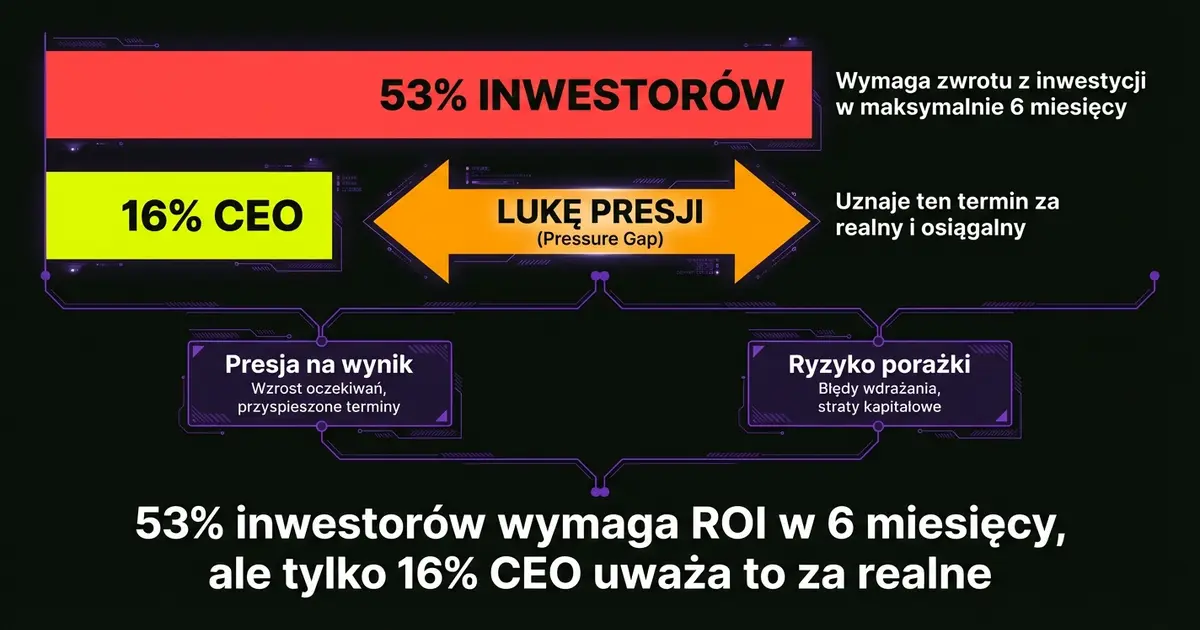
95% of AI projects get stuck in pilots. MIT NANDA confirms: most initiatives never move beyond testing phase. 2026 is the end of experiments – 53% of investors demand ROI in 6 months. Discover a concrete roadmap to measurable AI profits.

95% of AI initiatives never move beyond the testing phase. MIT NANDA confirms: most projects get stuck in "Pilot Purgatory" – endless pilots that consume budgets but deliver no profit. The problem? Companies treat AI like a gadget, not an investment with concrete ROI. 2026 is the end of this game. Investors are pushing: 53% demand returns in 6 months. CEOs had to start measuring results, not promises.
In a moment, you'll see 5 reasons why your company might join the 74% of projects with no measurable value – and a concrete roadmap to avoid it.
Pilot Purgatory: Why 2026 is the moment of truth for AI?
Your company has been testing a chatbot for 8 months. More meetings, presentations, "one more sprint". Cost: 200k PLN. Result: zero. Welcome to "Pilot Purgatory" – where 95% of AI initiatives die a natural death.
MIT NANDA conducted an analysis of 1400 AI projects. Result? Only 5% moved from pilot to production. The remaining 95% are stuck in endless testing. Why? Because companies confuse experimentation with investment.
2026 changes the rules of the game. BCG AI Radar 2026 shows: 75% of CEOs treat AI as a top 3 growth priority. This is no longer "let's see what comes out of this". It's "either it brings profit, or we're done".
The problem lies in the approach. Typical scenario in a Polish company:
- Month 1-3: Vendor selection, POC
- Month 4-6: "Testing features"
- Month 7-9: "Waiting for user feedback"
- Month 10+: "We need to work on..."
Meanwhile, costs grow: licenses, consultants, change management. ROI? Nobody measures it because "it's still a pilot".
Teneo Vision 2026 Survey confirms: 30% of GenAI projects will be abandoned after POC by end of 2025. Why? Lack of clear success metrics from day 1. Company tests "does it work" instead of "how much will it save".
The difference between Trailblazers (15% of companies scaling AI) and the rest? They set KPIs before launching the pilot:
- Save X hours of team time monthly
- Reduce costs by Y% in process Z
- Increase conversion by N percentage points
Without this, the pilot becomes an expensive hobby. And 2026 is the end of time for hobbies.
AI Investments: Where does 1.7% of revenue in the budget come from?
The average company spends 1.7% of revenue on AI today. Two years ago it was 0.8%. Goldman Sachs predicts: global spending in 2026 could reach 500 billion USD. Question: where does this number come from and is it a lot?
Let's compare with other departments:
- Marketing: 6-12% of revenue
- IT overall: 3-5% of revenue
- R&D: 5-15% (depending on industry)
AI already consumes 30-50% of IT budgets in tech companies. In banking and finance? About 2% of revenue goes directly to artificial intelligence (Conference Board 2026 Outlook).
Interestingly – not everyone spends the same:
- Tech and banking: 2%+ of revenue (leaders)
- Retail and e-commerce: 1.5-2% (average)
- Manufacturing and real estate: <1% (laggards)
Why such differences? Because some industries see direct AI impact on revenue. Amazon saves millions of dollars annually through AI in logistics (public data from quarterly reports). Netflix increases retention by 10-15% through AI recommendations (investor relations data).
The problem arises when a company spends 1.7% of revenue... but doesn't know on what. Typical AI budget breakdown in a Polish company (based on industry patterns):
- 40%: Licenses and platforms (OpenAI, Microsoft, Google)
- 25%: Consultants and implementations
- 20%: Infrastructure (servers, cloud)
- 15%: Training and change management
Where is the ROI? Nowhere. Because there's no line for "Measuring results and optimization". Company spends but doesn't track returns.
Teneo Vision 2026 shows: CEOs in India and China are 2x more confident in AI returns than in the US or UK. Why? Because they require concrete metrics from day zero. Not "will AI help", but "how much will we save in Q2".
If you're spending 1.7% of revenue on AI but don't have a dashboard with real-time savings – you're not investing. You're burning budget.
53% of investors expect returns in 6 months – new pressure
Your board asks: "When will we see AI profits?". You answer: "We need a year for testing". Board responds: "You have 6 months".
Welcome to 2026. Conference Board 2026 Outlook confirms: 53% of investors demand AI ROI in less than 6 months. This is a radical change. A year ago, the standard was 12-18 months.
The problem? Only 16% of large company CEOs think 6 months is realistic. 84% predict returns will take over a year. The disconnect between investor expectations and reality creates enormous pressure.
Where does this new urgency come from?
- Competition: If your competitor deploys AI faster, you're losing market share right now
- Cost of capital: Higher interest rates = investors demand faster returns
- Proof of concept: The market has seen enough case studies to know: it can be done faster
Spotify automated playlist personalization in 4 months – result: 30% increase in engagement in Q1 after deployment (data from public reports). Nike cut design time by 40% through AI in supply chain – ROI in 5 months (source: Nike Innovation Report).
If they can, why can't you?
Reality: most companies don't achieve ROI in 6 months because they make 3 mistakes:
Mistake #1: Starting with the hardest processes
Company tries to automate complex customer support. Result: 9 months of testing, zero production. Better: start with a simple process (e.g., ticket categorization) – ROI in 6-8 weeks.
Mistake #2: No baseline metrics
You don't know how much the process costs before AI. How do you measure savings? Set baseline in week 1: FTE cost, process time, error rate.
Mistake #3: Waiting for "perfect solution"
80% AI effectiveness in 2 months > 100% effectiveness in 12 months. Teneo shows: companies that iterate quickly achieve ROI 3x faster than those waiting for perfection.
41% of C-Suite leaders consider ROI measurement the #1 priority for 2026 (Conference Board). This is a higher priority than building AI expertise or recruiting talent. Why? Because without measurable returns, the budget disappears in Q3.
If you want to survive the 6-month pressure – start with Quick Wins. Small projects, fast returns, building momentum. Then you scale.
Automation Portfolio Audit: How to assess measurable success?
You have 5 AI projects. Which one brings profit? Which one eats budget? Most companies don't know. Why? Because there's no automation portfolio audit.
An audit is not an implementation report. It's a systematic evaluation of each AI project through the lens of hard numbers:
Audit framework (4 dimensions):
1. ROI Score (0-100 points)
- Time savings: X FTE hours/month × hourly cost
- Error reduction: Error cost × error rate difference
- Output increase: Additional transactions/leads × unit value
2. Time to Value (days to first results)
- <30 days: Quick Win (priority for scaling)
- 30-90 days: Standard (monitor)
- >90 days: Red flag (reconsider or kill)
3. Adoption Rate (%)
- How many users actually use AI?
- 80%+: Success
- 50-80%: Needs improvement
- <50%: Problem (often change management)
4. Scalability Potential (Low/Medium/High)
- Can it be replicated in other departments?
- What are the scaling barriers?
Example of a real audit (e-commerce industry pattern):
Project A: AI Chatbot customer support
- ROI Score: 45/100
- Savings: 120h/month (3k PLN)
- Cost: 5k PLN/month (license + maintenance)
- Verdict: Kill or pivot – cost > savings
Project B: AI product categorization
- ROI Score: 85/100
- Savings: 200h/month (15k PLN)
- Cost: 3k PLN/month
- Time to Value: 3 weeks
- Verdict: Scale immediately
Most companies don't do this audit. Result? 74% of projects with no measurable value (MIT NANDA). Not because AI doesn't work. Because nobody measured what works.
Teneo Vision 2026 shows: Trailblazers (15% of leaders) audit quarterly. The rest? Once a year, if at all. Difference in portfolio efficiency: 300%.
How to do an audit in practice?
- Step 1: List all AI initiatives (including pilots)
- Step 2: For each, set baseline KPI before implementation
- Step 3: Measure current KPI (after 1, 3, 6 months)
- Step 4: Calculate delta and multiply by cost/unit value
- Step 5: Decision: Scale, Improve, Kill
Audit tools:
- Excel/Google Sheets (sufficient to start)
- Power BI/Tableau (if you have many projects)
- Dedicated platforms (e.g., Workday Adaptive Planning)
Every 3 months ask: "If I started from scratch today, would I invest in this project?". If the answer is "no" – you have a problem.
AI Implementation Costs: How to avoid hidden expenses trap?
AI budget: 100k PLN. Actual cost after 6 months: 180k PLN. Where's the difference? Hidden expenses that nobody factored into ROI.
Typical AI implementation cost breakdown (based on industry patterns):
Visible costs (60% of budget):
- Platform licenses: 30k PLN/year
- Vendor implementation: 40k PLN
- Cloud infrastructure: 10k PLN
Hidden costs (40% of budget – often overlooked!):
- Change management: 20k PLN (training, team resistance)
- Legacy system integrations: 15k PLN
- Maintenance and optimization: 5k PLN/month
- Cost of testing errors: 10k PLN
Conference Board 2026 confirms: change management costs are the most underestimated element of AI budgets. Company assumes 10k PLN, but actually needs 30k PLN because the team resists.
41% of CEOs worry about lack of control over AI decisions – this translates to hidden audit and compliance costs. Example: company deploys AI in recruitment, after 3 months lawyer says "this violates GDPR". Redesign cost: 25k PLN.
How to avoid hidden costs?
1. Map Total Cost of Ownership (TCO) on day 1
Don't ask "how much does the license cost", ask "how much does a year of production operation cost?". Include:
- FTE needed for maintenance (0.5-1 FTE is standard)
- Cost of model retraining (if using custom ML)
- Compliance and audit costs
2. Assume 30% buffer for unexpected
If vendor says "100k PLN", plan for 130k PLN. There will always be additional integrations.
3. Watch out for vendor lock-in
AI platform for 50k PLN/year sounds ok. But what if after a year you want to switch vendors and migration costs 80k PLN? Ask about exit strategy.
4. Measure the cost of not having AI (opportunity cost)
If you don't deploy AI, how much do you lose? Example: CS team spends 500h/month on repetitive questions. Cost: 35k PLN/month. ROI from chatbot (cost 8k PLN/month): 27k PLN monthly net.
Goldman Sachs predicts 500 billion USD in global AI spending in 2026. Most of it will be hidden scaling costs – not just licenses.
If you don't plan TCO, your ROI is an illusion. Because you're counting AI savings but not deducting full maintenance costs.
AI Strategy for CEO: From experiments to hard data
65% of CEOs consider AI a top 3 growth priority (BCG AI Radar 2026). Problem? Most don't have a strategy – they have a collection of experiments.
Difference between strategy and experiments:
Experiments (Followers – 15% of CEOs):
- "Let's see what a chatbot does in CS"
- No connection to business goals
- ROI? "We'll see in a year"
- Decisions based on: "Competitors are doing it"
Strategy (Trailblazers – 15% of CEOs):
- "AI will reduce support cost by 30% in Q3"
- Clear map: which process, what KPI, when ROI
- Decisions based on: Hard data from pilots
Teneo Vision 2026 shows the pattern: CEOs who treat AI strategically achieve ROI 4x faster than those who "test".
How to build an AI strategy (not an experiment plan)?
5P Framework for CEO:
1. Purpose (Business goal)
Not "we're deploying AI", but "we're reducing cost X by Y% by quarter Z".
Example: "CAC (Customer Acquisition Cost) will drop 25% in H2 2026 through AI lead scoring".
2. Portfolio (Initiative map)
Classify each AI project:
- Quick Wins: ROI <3 months, low cost (30% of portfolio)
- Strategic Bets: ROI 6-12 months, high impact (50% of portfolio)
- Moonshots: ROI >12 months, exploratory (20% of portfolio)
Teneo: Trailblazers invest 70% of budget in Quick Wins + Strategic Bets. Followers? 60% in Moonshots.
3. People (Who is accountable)
41% of CEOs consider ROI measurement the #1 priority. Who measures? Often nobody. Set:
- AI Champion (C-level): Responsible for overall strategy
- Project Owners: Each project has an owner with KPI
- Steering Committee: Quarterly portfolio audits
4. Process (How we decide)
Clear criteria:
- Green light: ROI >200% in 6 months
- Yellow light: ROI 100-200% or strategic impact
- Red light: ROI <100% and no strategic justification
Spotify uses a similar framework – each AI experiment must show impact in 1-2 sprints or it gets killed.
5. Performance (How we measure)
Dashboard with 3 metrics:
- Portfolio ROI: Average return from all projects
- Time to Value: Average time to first results
- Scale Rate: % of projects moved from pilot to production
If Scale Rate <20%, you have a systemic problem (Pilot Purgatory).
Conference Board 2026: 75% of CEOs treat AI as a priority, but only 33% have a formal strategy with KPI. That's a gap between intention and execution.
Your AI strategy can't be a document in a drawer. It's a live dashboard that the board checks weekly.
Moving to Production: How to effectively scale AI in 2026?
Pilot worked. ROI: 250% in 3 months. Board says: "Let's scale!". After 6 months ROI drops to 80%. What went wrong?
The problem with scaling AI is not technology. It's organization.
MIT NANDA: 95% of AI projects get stuck in pilots because companies don't have a process for moving to production. They test, show results, and then... nothing. Missing playbook "what's next".
4 scaling barriers (and how to overcome them):
Barrier #1: Infrastructure
Pilot ran on 50 users. Production: 5000 users. Servers crash in week 2.
Fix:
- Load testing before scaling (simulate 10x traffic)
- Cloud auto-scaling (AWS, Azure, GCP)
- 24/7 monitoring (Datadog, New Relic)
Netflix scales AI recommendations to 200M+ users through microservices architecture – each model runs independently.
Barrier #2: Adoption (people don't use it)
Pilot: enthusiasts (early adopters) used AI daily. Production: 60% of team ignores the tool.
Fix:
- Mandatory onboarding (not optional)
- Champions in each team (power users training others)
- Gamification: AI usage leaderboard = bonus
Barrier #3: Data variability
Pilot trained on Q4 data. Production in Q2: model accuracy drops 40%. Why? Seasonality, product changes, new customers.
Fix:
- Continuous training (retrain model monthly)
- Drift monitoring (alerts when accuracy drops >10%)
- A/B testing: new model vs old, live comparison
Barrier #4: Lack of standards
Each department deploys AI its own way. Result: 15 different platforms, zero integration.
Fix:
- AI Governance: 1 platform for entire company (or max 2-3)
- Integration standards (API, webhooks)
- Centralized monitoring (one dashboard for all projects)
Teneo Vision 2026: Companies with formal AI Governance scale 3x faster. Why? Because they don't waste time "reinventing the wheel" in each department.
Scaling roadmap (8 weeks):
- Week 1-2: Infrastructure audit + load testing
- Week 3-4: Onboarding plan + champion training
- Week 5-6: Soft launch (20% of users) + monitoring
- Week 7-8: Full rollout + optimization based on feedback
Spotify scales new AI features in 6-8 weeks using this playbook. Nike cut AI supply chain scaling time from 6 months to 10 weeks through governance standards.
If your pilot works but scaling takes >4 months – the problem isn't technical. It's organizational readiness.
Measuring AI Effectiveness: Metrics that convince the board
Board asks: "Does AI work?". You answer: "The team is happy". Board: "That's not a metric".
You're right. Conference Board 2026: 41% of C-Suite leaders consider ROI measurement the #1 priority. Why? Because without hard numbers, AI is a cost, not an investment.
3 levels of AI metrics:
Level 1: Operational Metrics (for the team)
- Model accuracy: 85% → 92% (better predictions)
- Response time: 5s → 1.2s (faster response)
- Uptime: 99.5% (system availability)
These metrics matter to IT but the board doesn't care. Why? Because they don't show business impact.
Level 2: Efficiency Metrics (for managers)
- Process time: 4h → 30min (3.5h savings)
- Error rate: 12% → 2% (fewer errors)
- Throughput: 50 → 200 cases/day (more output)
Better. Manager sees: "process faster, fewer errors". But board asks: "How much in dollars?"
Level 3: Business Impact Metrics (for the board)
- ROI: (Savings - Cost) / Cost × 100%
Example: (50k PLN savings - 15k PLN cost) / 15k PLN = 233% ROI - Payback Period: How many months to recover investment
Example: 60k PLN cost, 12k PLN/month savings = 5 months payback - NPV (Net Present Value): Discounted value over time
Example: 200k PLN savings over 2 years at 10% discount rate = NPV ~170k PLN
This is business language. Board understands ROI, payback, NPV. They don't understand "accuracy increased by 7%".
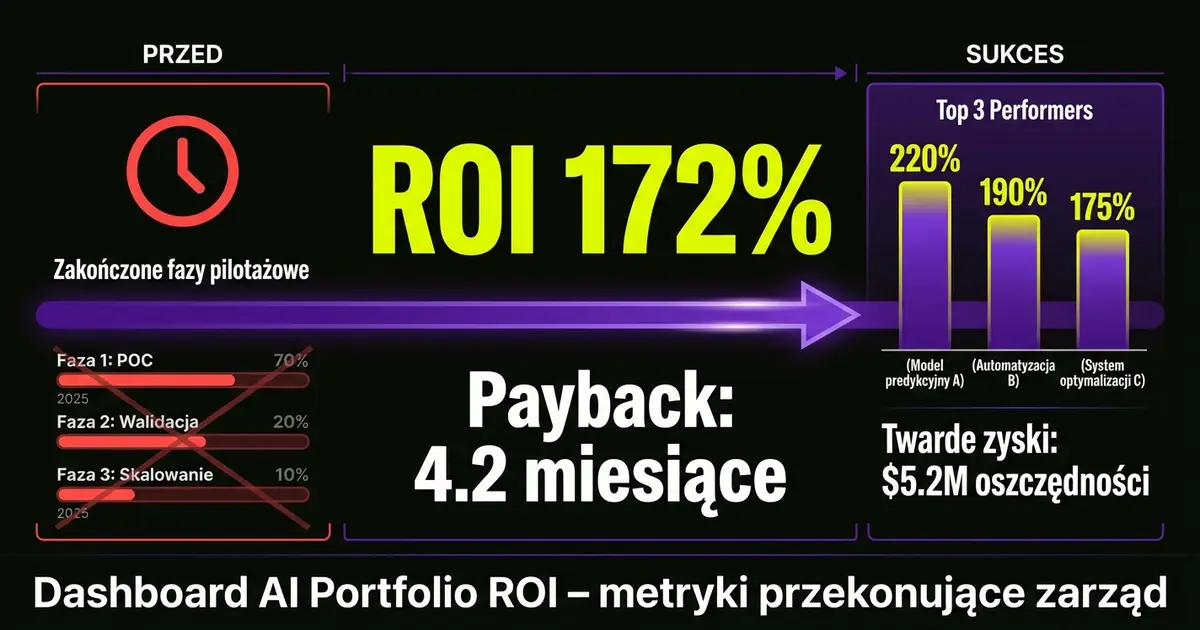
Metrics framework for CEO (1-page dashboard):
━━━━━━━━━━━━━━━━━━━━━━━━━━━━━━━━━
AI PORTFOLIO Q1 2026
━━━━━━━━━━━━━━━━━━━━━━━━━━━━━━━━━
Total Investment: 250k PLN
Total Savings: 680k PLN
────────────────────────────────
Portfolio ROI: 172%
Avg Payback: 4.2 months
Projects in Prod: 7/10 (70%)
━━━━━━━━━━━━━━━━━━━━━━━━━━━━━━━━━
TOP PERFORMERS:
1. AI Lead Scoring: ROI 340%, Payback 2m
2. Doc Processing: ROI 280%, Payback 3m
3. Chatbot CS: ROI 150%, Payback 5m
UNDERPERFORMERS:
1. AI Sales Coach: ROI 45%, Review needed
2. Predictive Maint: Still in pilot (6m)
━━━━━━━━━━━━━━━━━━━━━━━━━━━━━━━━━
This slide convinces the board. Why?
- They see ROI higher than cost of capital
- They see payback shorter than budget cycle
- They see which projects work (and which don't)
Teneo Vision 2026: Companies with executive AI dashboard get 2x more budget next year. Why? Because CFO sees returns.
How to calculate ROI in practice:
Example: AI in customer support
Savings:
- Before AI: 3 FTE × 8k PLN/month = 24k PLN/month
- After AI: 1 FTE (oversight) = 8k PLN/month
- Savings: 16k PLN/month = 192k PLN/year
Costs:
- Implementation: 40k PLN (one-time)
- License: 5k PLN/month = 60k PLN/year
- Maintenance: 1k PLN/month = 12k PLN/year
- Total Year 1: 112k PLN
ROI Year 1: (192k - 112k) / 112k = 71%
Payback: 112k / 16k per month = 7 months
These are concrete numbers the board understands. Not "AI helped the team", but "we saved 80k PLN net in year 1".
Business Process Automation: Where to find fast ROI?
Not all processes deliver the same ROI from AI. Some bring returns in 6 weeks. Others in 18 months. How to spot a Quick Win?
Quick Win AI Framework (3 criteria):
1. High repeatability (>80% similar cases)
Example: Invoice categorization – 90% of invoices have the same format. AI learns the pattern in 2 weeks.
Example NOT Quick Win: Contract negotiations – each contract unique, AI needs 6+ months of learning.
2. Clear business rules (if-then)
Example: Vacation approval – clear rules (tenure, day limit). AI automates 100%.
Example NOT Quick Win: Campaign creativity assessment – subjective, AI will make mistakes.
3. Available data (min. 500-1000 examples)
Example: Lead scoring – you have 5000 leads from history. AI trains model in a week.
Example NOT Quick Win: New product – 0 historical data, AI has nothing to learn from.
Top 5 processes with fastest ROI (industry patterns):
#1 Document categorization (Invoice, CV, tickets)
- ROI: 200-400%
- Payback: 2-4 months
- Savings: 60-80% of manual time
Example: Accounting firm processes 2000 invoices/month. Before AI: 80h work. After AI: 15h (verification). Savings: 65h × 50 PLN/h = 3250 PLN/month.
#2 Lead scoring and qualification
- ROI: 250-350%
- Payback: 3-5 months
- Impact: 30-50% conversion rate increase
Example: Sales team spends 40% of time on cold leads. AI filters top 20% = team focuses on hot prospects.
#3 Chatbot for FAQ and tier-1 support
- ROI: 150-300%
- Payback: 4-6 months
- Deflection rate: 40-60% of tickets
Example: CS receives 500 tickets/month, 60% are FAQ. Chatbot handles 300 tickets = saves 2 FTE.
#4 Report automation
- ROI: 180-280%
- Payback: 3-5 months
- Savings: 50-70% of analyst time
Example: Analyst spends 30h/month on reports. AI generates 80% automatically = 24h savings.
#5 Churn prediction / customer retention
- ROI: 200-400%
- Payback: 4-8 months
- Impact: 15-25% churn reduction
Example: SaaS loses 100 customers/month (500 PLN MRR). AI prediction + proactive outreach = retain 20 customers = 10k PLN/month additional MRR.
Where NOT to look for Quick Wins:
- ❌ High-variability processes (each case unique)
- ❌ Strategic decisions requiring business context
- ❌ Compliance/regulatory areas (long validation time)
- ❌ Processes without historical data
Teneo Vision 2026: Companies starting with Quick Wins achieve full portfolio ROI 2x faster than those starting with complex transformations.
If you want fast ROI – start with processes AI already does well. Don't reinvent the wheel.
Your 2026 Roadmap: 5 steps to measurable AI profit
You have the data. You know AI can bring ROI. Problem: how to start on Monday?
90-day roadmap (Q1 2026):
Week 1-2: Baseline Audit
- Map all AI projects (including pilots)
- Calculate TCO for each project (visible + hidden costs)
- Set baseline KPI for processes before AI
- Decision: which projects to kill, which to scale
Deliverable: Excel with project list, costs, KPI
Week 3-4: Quick Win Selection
- Identify 2-3 Quick Win processes (framework above)
- Set target ROI and payback for each
- Assign project owner (1 person accountable)
- Set weekly check-in (15min status)
Deliverable: Project brief (1-pager) for each Quick Win
Week 5-8: Pilot Execution
- Deploy Quick Win #1 (max 4 weeks)
- Weekly KPI monitoring
- If ROI >150% in week 4 → Scale plan
- If ROI <100% → Pivot or kill
Deliverable: ROI report after 4 weeks
Week 9-10: Scale Preparation
- Infrastructure load testing
- Onboarding plan (training, champions)
- Integration with other systems
- Monitoring setup (24/7 dashboard)
Deliverable: Scale checklist
Week 11-12: Executive Review
- Board presentation: ROI, payback, portfolio status
- Q2 budget: how much to scale, how many new Quick Wins
- Governance setup: who's responsible, how we decide
Deliverable: Executive dashboard (as in Measuring effectiveness section)
KPI at end of 90 days:
- Min. 1 project in production with ROI >150%
- Portfolio ROI >100% (total savings > total cost)
- Payback <6 months for all production projects
- Executive dashboard live (updated weekly)
Conference Board 2026: 75% of CEOs prioritize AI, but only 33% have an execution plan. This roadmap is your execution plan.
The decisive moment of 2026:
2026 is the end of "maybe we'll deploy AI someday". It's the year of "either measurable profit or kill the project". 53% of investors demand ROI in 6 months. 95% of pilots never reach production.
The question isn't "does AI work". The question is: "Does your company have a process to make AI profitable?"
If you don't have:
- Baseline KPI before AI
- TCO accounting for hidden costs
- Executive dashboard with ROI
- Playbook for scaling from pilot to production
...then you're in the 74% of projects with no measurable value.
Time to change. Start with an audit on Monday. Pick 1 Quick Win. Measure ROI in 4 weeks.
Or: stay in Pilot Purgatory and watch competitors pass you by.
Ready for measurable AI ROI?
LessManual helps companies move from pilots to production in 90 days. We audit your AI portfolio, identify Quick Wins, and build a roadmap with concrete ROI numbers.
Schedule a 30-minute call – I'll show you where your company is losing money on AI (and how to fix it).
Want to talk about automation?
Schedule a free consultation. 30 minutes, no obligations.
→ Book a call