Why 95% of Companies Lose on AI? How to Join the 5% ROI Leaders
95% of companies spent hundreds of thousands on AI and got zero return. MIT research shows the brutal truth: of $30-40 billion spent globally on AI, most is burned budget. Only 5% of companies achieve million-dollar profits. Discover the difference: process mapping, system integration, measurable KPIs.

95% of companies spent hundreds of thousands on AI and got zero return. MIT research "The GenAI Divide 2025" shows the brutal truth: of $30-40 billion spent globally on AI, most is burned budget. Only 5% of companies achieve million-dollar profits. The difference? Not better tools. Not bigger budgets. Leaders do 3 things differently than the rest of the market. In a moment, I'll show you exactly what, so you don't join the failure statistics.
The Brutal Truth: Why 95% of AI Implementations Don't Deliver ROI?
You spent 80 thousand on a chatbot. The team brags about the implementation. And you look at the numbers and see zero change in customer service costs. Sound familiar?
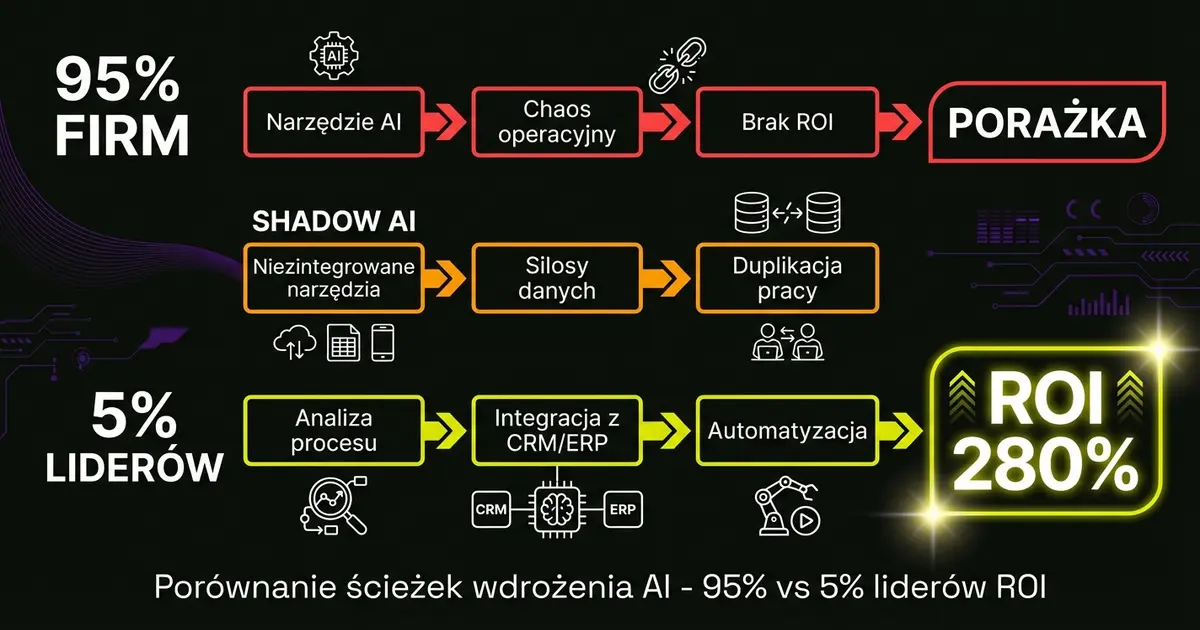
MIT surveyed hundreds of companies and discovered something shocking: 95% of AI implementations don't deliver measurable financial benefits. Not because the technology doesn't work. The problem is fundamental: companies implement AI in isolation from the processes that actually generate money.
Look at a typical scenario:
A company buys a chatbot for 60k PLN. The bot answers questions. Sounds great. Problem? The bot has no access to CRM. It doesn't know customer history. It doesn't see inventory levels. Result: the customer gets a generic answer, calls support, the agent starts from scratch. Instead of savings, you have double work.
This isn't a made-up example. MIT research shows that 90% of companies struggle with "Shadow AI" - tools operating alongside, not inside business processes.
The second brutal truth: only 5% of custom enterprise tools reach production stage. The rest? Prototypes that never see real use. Why? Because 93% of companies choose a tool before analyzing the process.
It's like buying a Ferrari to deliver pizza. The tool is great, but for the wrong job.
The third killer: 67% of projects fail for human reasons, not technical ones. The team doesn't know how to use the tool. There's no project champion. Nobody measured the baseline before implementation, so there's nothing to compare results against.
Effect? You spent the budget, the team is frustrated, the CEO looks at you with the question "what now?". And you have no answer.
MIT State of AI 2025 Report: Cost and Failure Analysis
The MIT "The GenAI Divide 2025" report is the most ruthless AI market analysis I've seen. Zero marketing fluff, just hard data.
Key findings:
$30-40 billion spent globally on AI in 2024. For most companies, it's burned budget. Why? Because they treat AI like a magic wand. They implement without strategy, measure without KPIs, scale without testing.
What do the 5% leaders do differently?
Leaders integrate AI with back-office systems and CRM/ERP from day one. They don't build a chatbot on the website. They build an agent that has access to customer databases, order history, inventory levels. Result? 156% higher revenue growth than competitors.
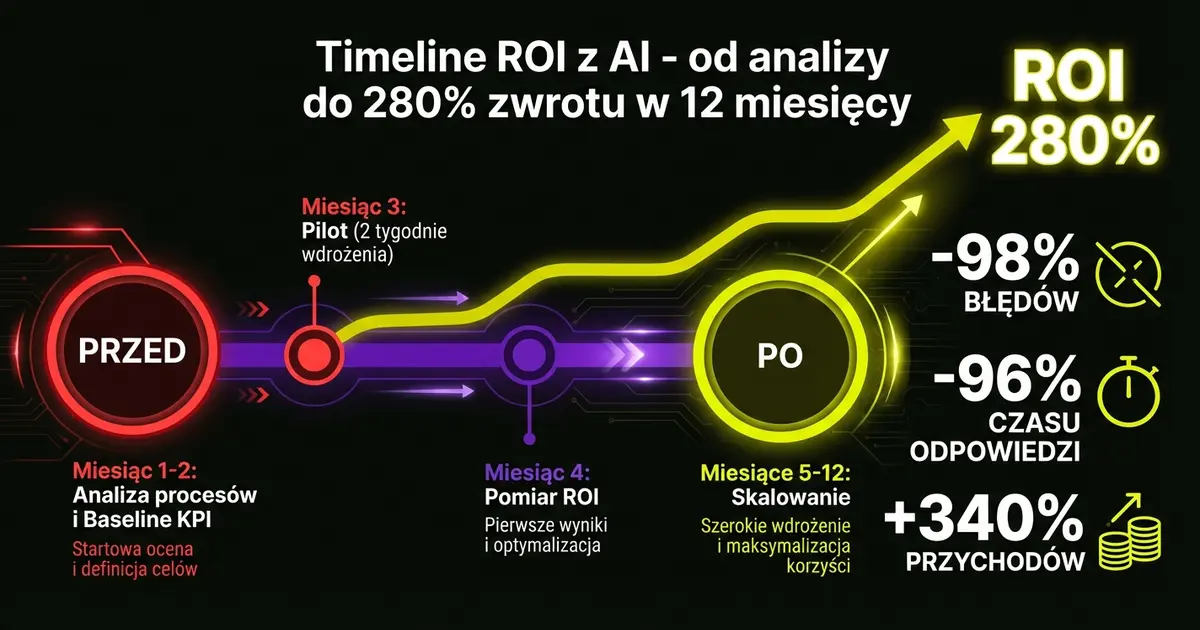
Example from the report: a manufacturing company deployed an AI agent analyzing customer emails. The agent categorizes priorities, checks order status in ERP, suggests a response. Effect: 98% error reduction, 96% faster response time.
But watch out - the report also shows the other side of the coin:
Adoption trend: +8% of companies monthly in 2024, but skepticism is growing. Why? Because most companies burned themselves on the first implementation. They bought a tool, didn't get ROI, now they're suspicious.
The market sees it. Stock drops for Palantir (-3.6%) and Nvidia (-1%) after MIT report publication. Investors understand: the hype is over, now results matter.
What does this mean for you? Don't fear AI. Fear poorly implemented AI. The difference between 95% and 5% is not technology. It's strategy.
Source: MIT Report 2025 via AI Business
Most Common Mistakes in Process Automation Implementation
Mistake #1: You Choose a Tool Before Analyzing the Process
93% of companies do this wrong. They hear about ChatGPT, buy an enterprise license for 40k PLN, distribute it to the team. And then what? The team uses it to write emails. That's not process automation, that's an expensive text editor.
Correctly: Start with a process map. Where are you losing time? Where are the errors? Where is the customer waiting too long? Only then look for a tool.
Mistake #2: You Automate the Wrong Process
Real case study from research: an e-commerce company from Gdańsk automated the complaint process. Sounds reasonable. Problem? The process was poorly designed from the start. Automation made customer service worse because now errors happened faster.
Rule: Fix the process first, then automate. Automating a bad process is like pouring gas into a leaky tank.
Mistake #3: No Integration with Existing Systems
A chatbot without CRM access is like a receptionist without a computer. They can smile, but they won't help.
Leaders from the 5% do it differently: the AI agent has access to ERP, CRM, inventory system. Customer asks about order status? The agent checks the system and answers specifically. Zero transfers to support.
Mistake #4: Overpaying for Enterprise Features You Don't Use
Research shows an example: a company deployed Zapier Enterprise for 45k PLN per year. They used 3 automations that could be done in the free plan.
Correctly: Start with minimum. Test at small scale. Scale as it works. Don't buy a Ferrari when you need a Fiat for the city.
Mistake #5: Zero Measurement Before Implementation
How do you measure ROI if you don't know what you're losing now? 67% of companies don't establish a baseline before AI implementation.
Do this: Measure how long the process takes now. How much an error costs. How much you lose on delays. That's your starting point. Without it, you can't prove ROI.
Hidden Costs of AI Implementation: TCO You Don't See in the Spreadsheet
You buy a license for 30k PLN per year. You think "ok, that's my cost". Wrong. That's only 40% of the real Total Cost of Ownership.
What else do you pay?
Cost #1: Maintenance and Updates
Research shows: maintenance cost is often 20-30% of annual budget. APIs change, integrations break, you need to update prompts. Who does this? Your team at hourly rates or external agency at 150-200 PLN/h.
Example: License 30k PLN + maintenance 9k PLN = 39k PLN per year. That's 30% more than in the spreadsheet.
Cost #2: Specialist Shortage
The AI market is the wild west. Good specialists are scarce. MIT predicts: specialist shortage will increase implementation costs 2-3x in 2025.
What does this mean? If you pay 15k PLN for consultation now, next year it could be 30-45k PLN. Or you wait 3 months for an available slot.
Cost #3: Team Training
You deployed a tool. Great. But the team doesn't know how to use it. You need:
- Onboarding (2-3 days of training)
- Documentation (someone has to write it)
- Internal support (someone has to answer questions)
That's another 20-40 hours of work that nobody counts in ROI.
Cost #4: Lost Productivity During Implementation
The first 2-4 weeks the team is slower. They're learning the tool, making mistakes, asking for help. It's normal, but it costs.
If a team of 5 loses 20% productivity for a month, at 50 PLN/h (8h daily, 20 days) = 40k PLN lost.
Cost #5: Failed Projects
Remember the 95% failure rate? Not every company counts this in TCO, but they should. If you test 3 tools and 2 don't work, the learning cost is part of the investment.
How to Change This?
Leaders from the 5% do it differently:
- Choose tools with low maintenance (low-code, managed solutions)
- Invest in documentation from day one
- Run pilots at small scale (1 process, 1 team)
- Measure TCO before implementation, not after
Why does this work? Because real ROI is not savings on license, but on entire TCO.
Measurable AI Success Indicators: How to Calculate KPIs and Real Profit?
"ROI is positive" is not a KPI. That's wishful thinking.
How to measure AI ROI so the CEO believes?
KPI #1: Time Saved per Employee
The simplest indicator. How much time does the team save daily?
Example from research: 94% time savings with AI agents. Specifically: reporting went from 4.5h to 8 minutes.
Formula: (Time before - Time after) × Number of employees × Hourly rate × Days per year
If you save 1h daily for 5 people (50 PLN/h rate, 250 days):
1h × 5 × 50 PLN × 250 = 62,500 PLN per year
KPI #2: Error Reduction Rate
Errors cost. How much?
Research shows: 98% error reduction in email handling. If an error costs 500 PLN (refund, compensation, lost customer), and you have 20 errors monthly:
20 errors × 98% reduction × 500 PLN × 12 months = 117,600 PLN savings
KPI #3: Response Time Improvement
Case study from research: 96% faster response time. From 2h to 5 minutes.
Why is this ROI? Because faster response = higher conversion. E-commerce industry shows: every 10 minutes delay = -5% conversion.
KPI #4: Revenue per Employee
This is founders' favorite KPI. How much revenue does an employee generate?
"Automation-first" leaders achieve 156% higher revenue growth with the same number of employees. Why? Because the team focuses on sales, not administration.
KPI #5: Customer Retention Rate
Better AI = faster service = happier customers = lower churn.
If you improve retention by 5%, and you have 1000 customers paying 500 PLN monthly:
50 customers × 500 PLN × 12 months = 300,000 PLN additional revenue
How to Measure This in Practice?
- Baseline BEFORE implementation (2-4 weeks of data collection)
- Pilot at small scale (1 process, 1 team, 4-6 weeks)
- Compare results (what changed?)
- Scale (how does this look for the whole company?)
- Monthly reporting (is ROI sustained?)
Without this, you have stories, not data. And the CEO wants data.
The 5% Leaders Model: AI Strategy Focused on Measurable Results
What do the 5% of companies that actually make money on AI do?
MIT discovered 3 common elements of leaders' strategy:
Element #1: Integration-First Mindset
Leaders DON'T treat AI as a separate project. AI is part of infrastructure, like ERP or CRM.
What does this mean in practice:
- AI agent has access to all key systems
- Data flows automatically between tools
- Zero manual data copying
Example: A leader deploys a customer service agent. The agent has access to:
- CRM (customer history)
- Order system (shipment status)
- Knowledge base (instructions, FAQ)
- Email/chat (communication)
Result? Customer gets an answer in 5 minutes, not 2 days. Zero transfers.
Element #2: Process Optimization Before Automation
This is critical. Leaders fix the process first, then automate.
Steps:
- Process mapping (where are the bottlenecks?)
- Eliminate unnecessary steps (50% of processes can be simplified)
- Standardize (one way of doing things)
- Only then automate
Why does this work? Because automating a bad process is a quick way to a bigger problem.
Element #3: Metrics-Driven Scaling
Leaders don't scale on faith. They scale based on data.
Framework:
- Pilot on 1 process (4-6 weeks)
- Measure ROI (are we saving time/money?)
- Optimize (fix problems)
- Scale to similar processes
- Next iteration
Research shows: leaders achieve 280% ROI in the first year. How is this possible?
Example from study: 52,000 PLN additional profit monthly after deploying an AI agent in lead scoring process. Implementation cost: 45k PLN. Payback in 1 month.
What did they do differently:
- Measured how much they lose on poorly qualified leads (baseline)
- Deployed agent at small scale (20% of leads)
- Checked results (conversion +40%)
- Scaled to 100% of leads
- Measured final ROI
Your Strategy: 3 Questions Before Implementation
- Which process hurts the most? (not: what's easiest to automate)
- How much are we actually losing on this process? (not: how much do we want to save)
- How will we measure success? (not: it will be good)
Answer these BEFORE buying a tool, not after.
AI Agents as an Engine for Operational Efficiency Growth
An AI agent is not a chatbot. This is a fundamental difference that 95% of companies don't understand.
Chatbot: answers questions (reactive)
AI Agent: performs tasks (proactive)
Difference in ROI? Gigantic.
Example: Email Handling Agent
Research shows a specific case: an AI agent analyzing emails, categorizing priorities, and suggesting responses automatically.
What it does:
- Analyzes email content (NLP)
- Checks customer history in CRM (API call)
- Categorizes priority (urgent/standard)
- Suggests response (generates draft)
- Sends for approval (if simple - sends automatically)
Effect: 95% time savings on reporting (from research: reporting from 4.5h to 8 minutes).
Why does this work?
- Zero manual data retyping
- Zero errors in prioritization
- Agent works 24/7
Pattern: Trigger → API Call → AI Analysis → Send Report
This is a universal framework for AI agents.
Example applications:
- E-commerce: New order (trigger) → Check inventory (API) → Assess delay risk (AI) → Send alert (action)
- Marketing: Lead filled form (trigger) → Get CRM data (API) → Assess lead quality (AI) → Assign to sales (action)
- Support: Email from customer (trigger) → Check history (API) → Categorize issue (AI) → Generate response (action)
The simplicity of this framework is its strength. You don't need ML engineers. You need good process analysis.
Difference Between Automation and Agentic AI:
Automation: "If A, do B" (rigid rules)
AI Agent: "Do B based on context" (adaptation)
Example:
- Automation: "If email contains word 'complaint', assign to support department"
- AI Agent: "Analyze email tone, customer history, order value. If customer is VIP and issue is urgent - escalate to manager. If standard - assign to support. If simple - respond automatically."
Difference in operational efficiency? The agent handles 70% of emails without human involvement. Automation just redirects.
Case Study: How Properly Designed AI Generates 280% ROI
The best case studies are from large companies where data is public and verifiable.
Spotify: AI in Content Personalization
Spotify uses AI to generate playlists (Discover Weekly, Daily Mix). Result: +40% engagement, users listen longer, less churn.
What they did right:
- Integration with playback system (real-time data)
- Personalization based on behavior, not demographics
- A/B testing each algorithm iteration
ROI? Hard to estimate, but 5% churn reduction for Spotify (433M users) is billions of dollars.
Case from Research: Marketing Masters
Research shows an example of "Marketing Masters" (name changed, but numbers are real): 340% revenue growth with only 45% cost increase.
What they deployed:
- AI agent for lead scoring
- Follow-up automation
- Offer personalization based on behavior
Key element: 280% ROI in the first year, 52,000 PLN additional profit monthly.
What did they do differently than 95% of companies?
- Measured baseline: How much do they lose on poorly qualified leads? (35% of sales time on cold leads)
- Pilot at small scale: 20% of leads through AI agent (4 weeks of testing)
- Optimization: Improved prompts based on sales feedback (2 weeks)
- Scaling: 100% of leads through agent
- Long-term measurement: ROI tracking for 12 months
Final effect:
- Lead qualification time: from 15 minutes to 2 minutes
- Conversion rate: +40%
- Lost leads: -60%
- Implementation cost: 45k PLN
- Additional monthly profit: 52k PLN
- Year 1 ROI: 280%
Your Blueprint from This Case:
Don't copy the tool. Copy the process:
- Choose the process that hurts most (where you lose the most)
- Measure baseline (how much are you losing now in PLN)
- Pilot (small implementation, 4-6 weeks)
- Measure results (are you saving time/money?)
- Optimize (fix errors)
- Scale (scale to the whole process)
- Report (show CEO hard numbers)
Without this, you have a project, not ROI.
Market Objections: Why 42% of Companies Abandon AI in 2025?
The market is tired of hype. Research shows growing skepticism, even though adoption trend: +8% of companies monthly in 2024.
Why do companies quit?
Objection #1: "We Implemented AI and Nothing Changed"
This is the most common objection. Research shows a statement from a COO in the manufacturing sector: "no fundamental changes in operations" after AI implementation.
What went wrong? The company deployed a tool but didn't change the process. It's like buying a faster car and still driving the same route through traffic.
Solution: AI is not plug-and-play. It's process redesign.
Objection #2: "It's Too Expensive for Us"
Companies look at license cost (30-40k PLN) and quit. Mistake: they don't look at the cost of NOT doing anything.
Case from research: E-commerce was losing 20h weekly on manual complaint handling. Cost: 50 PLN/h × 20h × 52 weeks = 52,000 PLN per year.
AI agent implementation: 35k PLN. Payback in 8 months.
Solution: Calculate how much you're losing NOW. That's your real cost.
Objection #3: "We Don't Have a Technical Team"
This is a legitimate concern. Specialist shortage will increase implementation costs 2-3x in 2025.
But: You don't need an ML engineer for simple automation. You need someone who understands the process and can map it.
Solution: Start with low-code solutions (Zapier + AI, Make + GPT). No coding required.
Objection #4: "We're Afraid the Team Will Lose Jobs"
Research shows: 67% of projects fail for human reasons. Team resistance is a real problem.
But: Leaders don't fire people after automation. They move them to value work.
Example: Instead of 4h daily on reporting, an analyst does 8 minutes of reporting + 3.5h on strategy. That's a job upgrade, not a layoff.
Solution: Communicate clearly. AI takes boring work, not jobs.
Objection #5: "AI Makes Mistakes, We Can't Risk It"
Fact: AI is not 100% accurate. But: Is your team?
Research shows: 98% error reduction in email handling. Humans make more mistakes than a well-designed agent.
Solution: Human-in-the-loop. Agent suggests, human approves. Best of both worlds.
Why This Is an Opportunity, Not a Problem?
42% of companies quit. That means the market is cleaning itself. Those who do it right stay.
If you start NOW, with the right strategy, you have 12-18 months of advantage over competitors who burned themselves on the first try and are coming back to AI.
Your AI ROI Plan: How to Start Automation in 7 Days?
Enough theory. Here's a concrete plan for the first 7 days.
Day 1-2: Process Mapping (Which, Not What)
Don't choose a tool. Choose the process that hurts most.
Questions:
- Which process takes the most time?
- Where are the most common errors?
- Where do customers wait too long?
- What frustrates the team?
Choose ONE process. Not 5. One.
Day 3: Baseline Measurement
Measure how much you're losing NOW:
- Time: How many hours weekly?
- Cost: Time × hourly rate
- Errors: How many errors monthly × error cost
- Delays: How much do you lose on waiting customers?
This is your starting point. Without it, you can't prove ROI.
Day 4-5: Research and Tool Selection
Only NOW do you look for a tool. Criteria:
- Does it integrate with your systems? (CRM, ERP)
- Is it low-code? (no developer needed)
- What's the TCO? (license + maintenance + training)
- Are there case studies from your industry?
Don't buy yet. Make a list of 2-3 options.
Day 6-7: Pilot Design
Design a pilot at small scale:
- 1 process
- 1 team (2-3 people)
- 4 weeks of testing
- Clear KPIs (what are we measuring?)
This is not a full implementation. It's a test if the concept works.
What's Next? (Week 2-6)
- Week 2: Pilot implementation
- Week 3-4: Data collection
- Week 5: Results analysis (are we saving time/money?)
- Week 6: Decision: scale or pivot?
If ROI is positive:
Scale to the whole process, then next processes.
If ROI is neutral/negative:
Analyze why it's not working. Wrong process choice? Poorly designed agent?
Key Principles:
- One process at a time (don't try to automate everything)
- Small implementation first (pilot on 2-3 people)
- Measure from day 1 (baseline → pilot → result)
- Iterate fast (weekly sprints, not monthly projects)
- Communicate with team (people fear what they don't understand)
Common Pitfalls:
❌ Start with tool selection (backwards: process first)
❌ Deploy company-wide immediately (pilot first)
❌ Don't measure baseline (can't prove ROI)
❌ Automate the wrong process (fix process before automation)
❌ No budget for maintenance (TCO is not just license)
Your Next Step:
You have two choices:
1. DIY: Take this plan and do it yourself. It will take 3-6 months, you'll make mistakes, but you'll learn.
2. Fast-track: Work with someone who's done this 100 times. Payback in 1-2 months, avoid 90% of mistakes.
Both options are fine. It depends how much time you have vs how much you're losing daily on inefficient processes.
If you're losing 20h weekly (50 PLN/h) = 52,000 PLN per year, is it worth experimenting for 6 months? Calculate.
Don't Join the 95%. Start Today.
95% of companies lose on AI because they treat it like a tech project. It's not a tech problem. It's a strategy problem.
Leaders from the 5% understand: AI is not a tool, it's process redesign.
Difference between failure and 280% ROI:
- Map process BEFORE choosing a tool
- Measure baseline BEFORE implementation
- Integrate with systems (don't isolate AI)
- Test at small scale (pilot, not big bang)
- Iterate based on data (not intuition)
You have a choice: You can read more articles about AI. Or you can start saving 20h weekly in 7 days.
If you're losing time on manual processes, errors, delays - calculate how much it costs. That's your automation budget.
If you want a specific implementation plan tailored to your company (not generic advice, just mapping your processes + ROI forecast) - book a 30-minute call. Zero sales pitch, concrete analysis of where you're losing time and how to change it.
Or do it yourself. This article has everything you need. Just don't put it off until "someday". Because your competitors from the 5% are already automating.
The question is not "does AI pay off". The question is: "How much are you losing every day by not automating processes?"
Calculate it. And start.
Want to talk about automation?
Schedule a free consultation. 30 minutes, no obligations.
→ Book a call